
Specifications
Surface Treatments
Certifications
- ISO 9001 - 2015 Certified
- PED 2014/68/EC
- NACE MR0175/ISO 15156-2
- NORSOK M-650
- DFAR
- MERKBLATT AD 2000 W2/W7/W10
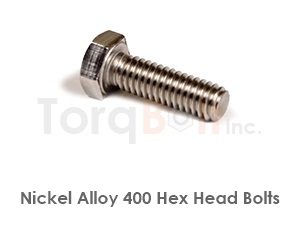
Monel 400 heavy hex bolts (also catalogued as UNS N04400 heavy hex cap screws, nickel-copper heavy hex bolts, ASTM F468 heavy hex bolting and DIN 6914 Monel heavy hex) carry a larger head profile than the standard finished hex pattern. The chemistry sits under ASTM F468 with bar feedstock from ASTM B164; the alloy registers as UNS N04400. Heavy hex head geometry follows ASME B18.2.1 in the imperial series and DIN 6914 in the metric high-strength series. Monel® is a registered trademark of Special Metals Corporation; TorqBolt is not authorized by, affiliated with or endorsed by Special Metals. The heavy hex pattern is the default specification on flanged pressure-boundary bolting, naval bulkhead studding and any joint where the wrench transmits a high preload without bearing the flat into the mating surface.
Heavy hex carries a wider wrench-flat (width across flats) and a taller head than the standard finished hex cap screw at the same thread diameter. The wider flat distributes torque over a larger bearing area; the taller head resists shear at the head-to-shank radius. The table reads thread diameter against the head-pattern class in standard hex and heavy hex.
| Thread | Standard hex pattern | Heavy hex pattern | Typical use |
|---|---|---|---|
| 1/2 in | Finished hex (ASME B18.2.1) | Heavy hex (ASME B18.2.1) | ASME B16.5 small-bore flange |
| 5/8 in | Finished hex | Heavy hex | Class 300 flange bolting |
| 3/4 in | Finished hex | Heavy hex | Class 600/900 flange bolting |
| 1 in | Finished hex | Heavy hex | Pressure-vessel cover bolting |
| 1-1/4 in | Finished hex | Heavy hex | Compressor casing studding |
| M16 | DIN 933 / DIN 931 | DIN 6914 | EN 1591 flange joint |
| M24 | DIN 933 / DIN 931 | DIN 6914 | Naval bulkhead through-bolt |
| M30 | DIN 933 / DIN 931 | DIN 6914 | Structural high-strength joint |
Imperial head dimensions follow ASME B18.2.1 heavy hex bolts and heavy hex screws (width across flats, width across corners, head height, fillet radius). Metric heavy hex follows DIN 6914 (Sechskantschrauben mit grossen Schluesselweiten fuer Stahlkonstruktionen) which is the high-strength heavy hex bolt for steel-structure preload joints. DIN 6914 mates with DIN 6915 nuts and DIN 6916 hardened round washers. ASTM F468 does not redefine head geometry; it points to the dimensional standard via clause 7.1.3. Where the procurement document calls out heavy hex without specifying imperial or metric, default to ASME B18.2.1 in inch programmes and DIN 6914 in metric programmes.
Heavy hex is uncommon below half-inch imperial and M12 metric because the bearing-area gain over standard hex falls below the wrench-clearance penalty. Stock range below is the working envelope on Monel 400 heavy hex.
| Series | Diameter range | Length range | Head pattern | Thread pattern |
|---|---|---|---|---|
| Imperial | 1/2 in to 1-1/2 in (indent to 2-1/2 in) | 1-1/2 in to 12 in | ASME B18.2.1 heavy hex | ASME B1.1 UNC, UNF, 8UN |
| Metric | M12 to M36 (indent to M48) | 50 mm to 300 mm | DIN 6914 | ISO 261 coarse, ISO 262 fine |
Imperial heavy hex bolts are produced with ASME B1.1 UNC (coarse) or UNF (fine) threads; 8UN threads are used above 1-1/2 in where the standard coarse pitch drops off. Metric heavy hex on DIN 6914 carries ISO 261 coarse pitch by default. Rolled threads are the manufacturing default to F468 clause 4.2.4 (rolled or cut at the option of the manufacturer); cut threads ship on request for repair work. Thread engagement on a heavy hex joint should clear at least one nut height above the load-bearing surface to develop full F468 yield without thread strip.
Heavy hex head geometry does not change the mechanical certification of the bolt. The F468 property markings apply by chemistry and thread diameter regardless of head pattern. Source: ASTM F468/F468M-2016 Table 2.
| Marking | Diameter (in) | Hardness | Tensile (ksi) | Tensile (MPa) | Yield min (ksi) | Yield min (MPa) | Elongation |
|---|---|---|---|---|---|---|---|
| F 468U | 0.500 to 0.750 | 75 HRB to 25 HRC | 80 to 130 | 552 to 896 | 40 | 276 | 20% |
| F 468U | 0.875 to 1.500 | 60 HRB to 25 HRC | 70 to 130 | 483 to 896 | 30 | 207 | 20% |
| F 468U4 | 0.875 to 1.500 | 75 HRB to 25 HRC | 80 to 130 | 552 to 896 | 40 | 276 | 20% |
| F 468HF | all | 60 to 95 HRB | 70 to 120 | 483 to 827 | 30 | 207 | 20% |
| F 468V (R-405) | all | 60 HRB to 20 HRC | 70 to 125 | 483 to 862 | 30 | 207 | 20% |
F468 hardness cap of 25 HRC clears the 35 HRC sour-service ceiling in NACE MR0175 by design. Heavy hex bolting on a sour flange ships with EN 10204 type 3.2 and the NACE compliance statement (see sour service applications).
Match the nut chemistry to the bolt to keep the joint galvanically neutral. Imperial heavy hex bolts pair with Monel 400 heavy hex nuts to ASTM F467 with ASME B18.2.2 dimensions. Metric heavy hex on DIN 6914 pairs with DIN 6915 Monel hex nuts. Where the joint requires a hardened structural washer for preload concentration, ASTM F436 specifies the geometry; the equivalent metric washer is DIN 6916. Verify the washer chemistry against the joint corrosion regime; carbon-steel washers under a Monel head will pit at the bolt interface in chloride or HF service. See full washers list and the Monel 400 nuts family.
Heavy hex Monel 400 bolting is specified on three families of joint. First, ASME B16.5 and B16.47 flanged pressure boundaries on hydrofluoric-acid alkylation, sour gas, and chlorinated process service; pair with Monel 400 flanges or stud bolt assemblies depending on the gasket retraining torque. Second, pressure-vessel cover bolting on high-pressure separators and HF storage drums, where the larger head bearing distributes torque without crushing the cover seat. Third, naval bulkhead and topside structural joints (marine applications) where the non-magnetic, chloride-resistant property bundle is the design driver. Monel 400 heavy hex also serves on geothermal wellhead bolting and high-purity dimethylhydrazine handling lines where standard carbon-steel preload would corrode through within one inspection cycle.
When is heavy hex specified over standard hex? On flanged pressure boundaries (ASME B16.5), high-preload structural joints (EN 1591), and any service where the wrench would damage a standard finished-hex bearing flat. The larger across-flats and head height carry torque without indent.
What sizes does Monel 400 heavy hex run? Imperial 1/2 in through 1-1/2 in standard, indent to 2-1/2 in. Metric M12 through M36 standard, indent to M48. Below 1/2 in or M12 the standard hex bolt is used because the heavy-hex wrench-clearance penalty exceeds the bearing gain.
What is the companion nut? ASTM F467 Monel 400 heavy hex nut for imperial, DIN 6915 Monel nut for metric. Add ASTM F436 hardened structural washer where the joint requires preload concentration; check washer chemistry against the corrosion regime.
Does heavy hex change the F468 mechanical certificate? No. F468 marks chemistry and mechanicals by thread diameter; head pattern is a separate ASME B18.2.1 or DIN 6914 dimensional callout. The mill test certificate reads the same F 468U / F 468U4 / F 468HF / F 468V marking as the standard hex cap screw.
Cross-reference: full Monel 400 bolts family, standard hex bolts, heavy hex nuts, stud bolts, ASTM F468 standard landing. Compare against Monel 400 vs stainless steel on the bolting decision.
Send diameter, length, thread series (UNC, UNF, 8UN, ISO coarse), head pattern (ASME B18.2.1 heavy hex or DIN 6914), applicable F468 marking and quantity to info@torqbolt.com or WhatsApp +91-22-66157017. Ex-Mumbai price and lead time returned within one working day. Domestic India 3 to 7 working days; export through JNPT.