Specifications
Surface Treatments
Certifications
- ISO 9001 - 2015 Certified
- PED 2014/68/EC
- NACE MR0175/ISO 15156-2
- NORSOK M-650
- DFAR
- MERKBLATT AD 2000 W2/W7/W10
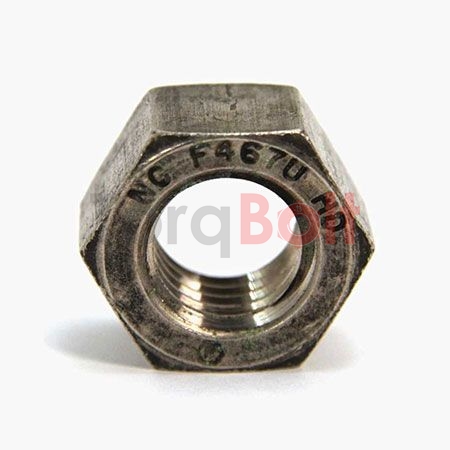
Monel® 400 nuts (also called UNS N04400 nuts, nickel-copper 400 nuts, Alloy 400 hex nuts) sit on the nut side of every Monel 400 bolting line item used in HF alkylation, sour-gas trees, seawater service and naval non-magnetic joints. The governing specification is ASTM F467 for commercial wrought nonferrous nuts 1/4 in. through 1-1/2 in. inclusive. Two compositions are recognised: Class A (UNS N04400, weldable, marked F 467U) and Class B (UNS N04405, free-machining, marked F 467V). Nut blanks are cut from ASTM B164 bar of the matching alloy and class, so a single heat lot feeds the F 467U nut and its F 468U bolt on the same job number. Monel is a registered trademark of Special Metals Corporation; TorqBolt is not authorized by, affiliated with or endorsed by Special Metals.
Class A is the welding-grade nut: the 0.024 percent sulfur ceiling preserves hot ductility in the heat-affected zone so a Class A nut tack-welded to a flange or an alloy 400 structural insert behaves predictably. Class B carries a controlled sulfur addition (0.025 to 0.060 percent) that breaks chips on capstan lathes and screw machines and yields a cleaner thread on long production runs, but the same sulfur disqualifies the nut from any welded joint. Choice of class is driven by the joint, not the bolt: a screw-machine joint that stays unwelded pairs an F 468V bolt with an F 467V nut; a flanged joint with weld stops or seal welds pairs F 468U with F 467U.
| F467 Class | UNS | Sulfur (%) | F467 marking | Use case |
|---|---|---|---|---|
| A (Ni 400) | N04400 | 0.024 max | F 467U | Weldable nuts; sour-service mating; HF alkylation flange joints |
| B (Ni 405) | N04405 | 0.025 to 0.060 | F 467V | Free-machining nuts where the joint stays unwelded |
F467 section 7.1 calls dimensions to ASME B18.2.2 for the regular series (hex, heavy hex, jam, slotted, castle). Coupling, wing and lock nuts are produced from the same F467 chemistry and mechanical floor with dimensions per the ASME B18, DIN or ISO standard on the purchase order. Hex nuts are the default for general bolting. Heavy hex nuts are mandatory on ASME B16.5 raised-face flange joints and high-pressure piping. Lock nuts ship in three variants: all-metal prevailing-torque (DIN 980V), nylon insert (DIN 985 / ISO 7040, service below 120 degC), and serrated flange (DIN 6923). Coupling nuts (length typically 3x diameter) join two threaded rods end to end. Square nuts to ASME B18.2.2 and wing nuts to DIN 315 are stocked in F 467U chemistry for legacy structural and process-side requirements.
F467 covers 1/4 in. through 1-1/2 in. inclusive. Metric sizes M5 through M64 are produced under DIN 934 (hex), DIN 6915 (heavy hex HV) and ISO 4032 / ISO 4033 with chemistry traced back to F467 Class A or B on the purchase order. Above 1-1/2 in. or M48 the supply chain moves to ASTM B564 forging stock cut to ASME B18.2.2 heavy hex with mechanicals matched to the F 467U floor.
| Diameter (in) | UNC tpi | UNF tpi | Metric equivalent | Heavy hex AF (in) |
|---|---|---|---|---|
| 1/4 | 20 | 28 | M6 | 1/2 |
| 3/8 | 16 | 24 | M10 | 11/16 |
| 1/2 | 13 | 20 | M12 | 7/8 |
| 5/8 | 11 | 18 | M16 | 1-1/16 |
| 3/4 | 10 | 16 | M20 | 1-1/4 |
| 7/8 | 9 | 14 | M22 | 1-7/16 |
| 1 | 8 | 12 | M24 | 1-5/8 |
| 1-1/4 | 7 | 12 | M30 | 2 |
| 1-1/2 | 6 | 12 | M36 | 2-3/8 |
F467 section 7.2 calls threads to ASME B1.1 Class 2B, UNC coarse or UNF fine. The 8UN thread series is available from 1-1/8 in. up. DIN 934 hex nuts and DIN 6915 heavy hex nuts use ISO metric coarse pitch per ISO 261; fine pitch follows ISO 262. Each nut carries two marks per F467 section 17.1: a manufacturer symbol plus the property mark (F 467U for Class A, F 467V for Class B), raised or depressed at the manufacturer option. Shipping units are labelled with ASTM designation, alloy number, property mark, size, manufacturer name, piece count, country of origin and purchase order number (section 17.3).
Class A and Class B share an identical chemistry envelope except for sulfur. Copper is the balance after the named elements are deducted; cobalt counts as nickel per F467 Table 1 Note B. The chemistry mirrors ASTM B164 bar, which means the same B164 R-400 or R-405 heat lot can feed both F 467U nuts and F 468U bolts on the same line item with a single mill test certificate.
| Element | Class A (UNS N04400) | Class B (UNS N04405) |
|---|---|---|
| Nickel + Cobalt | 63.0 to 70.0 % | 63.0 to 70.0 % |
| Copper | balance | balance |
| Iron, max | 2.5 % | 2.5 % |
| Manganese, max | 2.0 % | 2.0 % |
| Carbon, max | 0.3 % | 0.3 % |
| Silicon, max | 0.5 % | 0.5 % |
| Sulfur | 0.024 max | 0.025 to 0.060 |
F467 Table 2 sets a hardness minimum and a proof-stress minimum by alloy and product class. The heavy hex proof stress is 1.08 times the regular hex value (Table 2, Note B). F467 sets no upper hardness limit on Class A nuts; the voluntary 25 HRC cap that F468 places on Class A bolts is extended to the matching F 467U nut on the purchase order, leaving a comfortable margin below the NACE MR0175 35 HRC sour-service ceiling. Hardness is taken on the top or bottom face per F467 section 12.2.2. Proof load testing per ASTM F606 takes precedence when both proof load and hardness are run (F467 section 6.2).
| Marking | Alloy | Hardness, min | Hex proof stress, min (ksi) | Heavy hex proof stress, min (ksi) |
|---|---|---|---|---|
| F 467U | Ni 400 (Class A) | 75 HRB | 80 | 86 |
| F 467V | Ni 405 (Class B) | 60 HRB | 70 | 76 |
Pair the nut chemistry to the bolt chemistry to keep galvanic potential matched: F 467U with F 468U for Class A welded joints; F 467V with F 468V for Class B unwelded joints. The bolt overview is on Monel 400 bolts; variants on hex bolts, heavy hex bolts and stud bolts. Washers in DIN 125 plain, DIN 9021 fender, DIN 127 spring and DIN 6798 serrated. Sour-service shipments add the NACE MR0175 / ISO 15156 compliance statement and an EN 10204 type 3.2 certificate witnessed by a third-party surveyor. HF alkylation orders cite HF acid resistance and HF alkylation service.
Q. What Monel 400 nut types are covered by ASTM F467? F467 covers hex, heavy hex, jam, slotted and castle nuts in Class A (F 467U) and Class B (F 467V) from 1/4 in. through 1-1/2 in. Coupling nuts, wing nuts and lock nuts ship to F467 chemistry and mechanical floor with dimensions per the ASME B18 or DIN standard on the purchase order.
Q. Heavy hex vs standard hex Monel 400 nuts? Heavy hex has larger across-flats and greater thickness (ASME B18.2.2 heavy series) and carries a proof stress 8 percent higher than the standard hex value at the same grade. For F 467U, regular hex is 80 ksi minimum; heavy hex is 86 ksi minimum. Heavy hex is the default for ASME B16.5 flange bolting.
Q. What Monel 400 lock nut variants exist? Three variants are stocked: all-metal prevailing-torque (DIN 980V), nylon insert (DIN 985 / ISO 7040, service below 120 degC), and serrated flange (DIN 6923 / IFI 145). All three are produced from F 467U chemistry; the nylon-insert grade is restricted by the polyamide retainer temperature.
Nut variants under the F467 umbrella: Monel 400 hex nuts (ASME B18.2.2 regular), heavy hex nuts (ASME B18.2.2 heavy, 1.08x proof stress), lock nuts (prevailing torque, nylon insert, serrated flange). Companion bolting: Monel 400 bolts. Specifications: ASTM F467 (nuts), ASTM F468 (bolts).
Send size (diameter and threads per inch or metric pitch), F467 class (A or B), nut form (hex / heavy hex / jam / lock / coupling), quantity and applicable end-spec to info@torqbolt.com or WhatsApp +91-22-66157017. Ex-Mumbai price and lead time returned within one working day. Domestic India 3 to 7 working days; export through JNPT. Full Monel 400 alloy reference on the main reference; alloy designation detail on UNS N04400.