

Specifications
Surface Treatments
Certifications
- ISO 9001 - 2015 Certified
- PED 2014/68/EC
- NACE MR0175/ISO 15156-2
- NORSOK M-650
- DFAR
- MERKBLATT AD 2000 W2/W7/W10

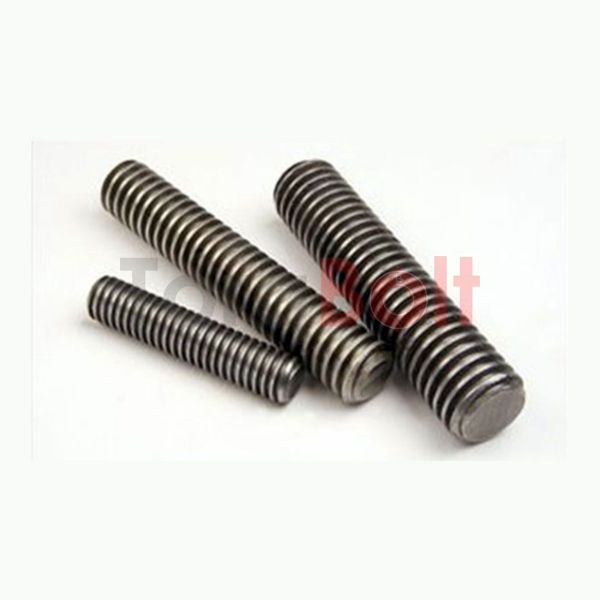
Monel® 400 stud bolts (also called Monel 400 studs, Monel 400 flange studs, or UNS N04400 sour-service studs) are the workhorse fastener for flange joints that see hydrofluoric acid, sour gas at NACE MR0175 limits, brackish-water heat exchanger channels, or a non-magnetic spec on a naval bulkhead. The stud is covered by ASTM F468 Section 7.2 (continuous thread, double-end clamping, double-end interference). Chemistry comes from ASTM B164 bar. Larger diameters come from ASTM B564 forging stock. The alloy registers as UNS N04400. NACE MR0175 sour service compliance is automatic when the F468 25 HRC hardness cap is met. Monel is a registered trademark of Special Metals Corporation; TorqBolt is not authorized by, affiliated with or endorsed by Special Metals.
F468 Section 7.2 names three stud geometries; the procurement spec selects one. Full-thread studs (DIN 975 metric, ASME B18.31.3 imperial) carry thread end to end and clamp the flange between two nuts. Double-end clamping studs (also called stud bolt or bolt stud) have a plain shank in the middle with threaded ends of equal length; this is the geometry referenced by the legacy "B7 style" callout on flange bolting drawings. Double-end interference studs (tap-end) have one short threaded end with an interference fit for blind-hole tapping and one nut-end for the through-flange clamp.
| F468 stud type | Common name | Standard | Flange-bolting use case |
|---|---|---|---|
| Continuous thread (7.2) | Full-thread stud | DIN 975 / ASME B18.31.3 | Heat-exchanger channels, raised-face flanges, threaded rod cut to length |
| Double-end clamping (7.2) | Stud bolt, bolt stud (B7 geometry) | ASME B18.31.2 / DIN 939 equivalent | Standard ASME B16.5 / B16.47 flange pairs; two heavy hex nuts |
| Double-end interference (7.2) | Tap-end stud | ASME B18.31.2 | Blind tapped flange or pressure-vessel cover; one nut, one tap end |
F468 envelope is 0.250 in. through 1.500 in. nominal thread diameter. Stocked metric sizes are M6 through M40 in DIN 975 full thread and DIN 939 double-end forms. Sizes M48 through M64 are manufactured on indent through ASTM B564 forging stock with mechanical properties matched to the F468 "Heavy Forged Equivalent" callout. Stocked imperial sizes are 1/4 inch through 1-1/2 inch in ASME B1.1 UNC class 2A. Length is cut to the flange bolt-up plus two nut heights plus a two-thread protrusion per ASME PCC-1.
| Diameter | UNC tpi | UNF tpi | Tensile area UNC (sq.in) | Stocked length (in) |
|---|---|---|---|---|
| 1/4 | 20 | 28 | 0.0318 | 1 to 6 |
| 3/8 | 16 | 24 | 0.0775 | 1 to 8 |
| 1/2 | 13 | 20 | 0.1419 | 1-1/4 to 10 |
| 5/8 | 11 | 18 | 0.226 | 1-1/2 to 12 |
| 3/4 | 10 | 16 | 0.334 | 1-3/4 to 14 |
| 7/8 | 9 | 14 | 0.462 | 2 to 16 |
| 1 | 8 | 12 | 0.606 | 2-1/4 to 18 |
| 1-1/4 | 7 | 12 | 0.969 | 2-3/4 to 20 |
| 1-1/2 | 6 | 12 | 1.405 | 3 to 24 |
Threads on Monel 400 stud bolts are produced per ASME B1.1 Class 2A (F468 Section 7.3.1, gaging per ASME B1.3 system 21). For full-thread studs the metric reference is DIN 975 (continuous thread rolled or cut, 6g tolerance). Double-end studs follow ASME B18.31.2. F468 leaves threading method (rolled or cut) at the manufacturer's option for sizes outside the socket-head cap-screw envelope. Rolled threads are the TorqBolt default through 1 inch diameter for better fatigue performance on flowing-seawater service; cut threads are used on M48 to M64 forged stock. Surface discontinuities are bound by ASTM F788 referenced in F468 Section 7.
F468 Table 2 sets the mechanical floor for Monel 400 (UNS N04400) studs by nominal thread diameter. Hardness is capped at 25 HRC across the diameter range, tighter than the NACE MR0175 35 HRC ceiling for nickel-copper bolting. Yield drops from 40 ksi (276 MPa) in the 0.250 to 0.750 in. band to 30 ksi (207 MPa) in the 0.875 to 1.500 in. band; the heavy forged equivalent (F 468HF) holds 30 ksi yield across all diameters. Elongation minimum is 20 percent. Source: ASTM F468/F468M-2016 Table 2.
| Marking | Diameter (in) | Hardness | Tensile (ksi) | Tensile (MPa) | Yield min (ksi) | Yield min (MPa) | Elongation |
|---|---|---|---|---|---|---|---|
| F 468U | 0.250 to 0.750 | 75 HRB to 25 HRC | 80 to 130 | 552 to 896 | 40 | 276 | 20% |
| F 468U | 0.875 to 1.500 | 60 HRB to 25 HRC | 70 to 130 | 483 to 896 | 30 | 207 | 20% |
| F 468U4 | 0.875 to 1.500 | 75 HRB to 25 HRC | 80 to 130 | 552 to 896 | 40 | 276 | 20% |
| F 468HF | all (forged equiv.) | 60 to 95 HRB | 70 to 120 | 483 to 827 | 30 | 207 | 20% |
Monel 400 stud bolts must clamp through Monel 400 nuts in matching chemistry to keep the joint galvanically continuous. The reference grade is ASTM F467 nickel-copper hex nut, equivalent in form to A194 grade 2H but in N04400 chemistry. Monel 400 heavy hex nuts are the default for ASME B16.5 raised-face flange bolting; standard hex nuts are used on light-duty heat-exchanger covers; lock nuts handle vibration on naval brackets. Monel 400 washers come in DIN 125 plain, DIN 9021 fender, DIN 127 spring, and DIN 6798 serrated forms; F436 is the closest carbon-steel washer reference but the alloy is changed to N04400.
F468 caps hardness at 25 HRC across all diameters. The NACE MR0175 / ISO 15156-3 ceiling for nickel-copper bolting is 35 HRC, so the F468 hardness gate is 10 HRC stricter than NACE by design. A Monel 400 stud bolt produced to F468 passes the NACE MR0175 hardness test with no special heat treatment. The full sour qualification still requires verifying H2S partial pressure and chloride concentration against ISO 15156-3 Annex A.4 for the operating envelope. Sour-service shipments ship with EN 10204 type 3.2 mill test certificate plus the NACE MR0175 compliance statement. Detail on sour service applications.
The dominant Monel 400 stud bolt application is HF alkylation flange bolting. Refinery HF alkylation units run isobutane with hydrofluoric acid at 70 to 95 percent concentration; nothing else in the bolting catalog survives, and API RP 751 names Monel for the wetted bolting position. Detail on HF alkylation and HF acid resistance. Sour-gas flange bolting on upstream production trees, manifolds, and choke valves at NACE MR0175 limits is the second-largest use. Brackish-water heat-exchanger channels on offshore platforms and seawater-cooled condensers (marine applications) follow. Naval bulkheads use Monel 400 stud bolts where the magnetic permeability spec rules out carbon steel.
What is a Monel 400 stud bolt? A threaded fastener in UNS N04400 nickel-copper alloy manufactured to ASTM F468. Full-thread studs run threads end to end; double-end studs have a plain shank between threaded ends. Used for flange bolting in HF, seawater, sour gas, and naval service.
How does ASTM F468 compare to ASTM A193 Grade B7? A193 B7 is a chromium-molybdenum alloy steel (4140 class) used for clean high-temperature flange bolting. F468 covers Monel 400 (and other nonferrous alloys) for flange bolting where B7 cannot survive: HF alkylation acid, seawater, hot caustic, sour gas above NACE H2S thresholds. Thread geometry (ASME B1.1, continuous thread, double-end clamping) matches; the alloy and corrosion envelope are the operative difference.
What is NACE MR0175? NACE MR0175 / ISO 15156 is the materials standard for sour service in upstream oil and gas (any service with H2S partial pressure above 0.05 psi). Annex A.4 of ISO 15156-3 lists nickel-copper bolting at 35 HRC max. F468 sets 25 HRC max, so the F468 hardness gate is automatically inside the NACE envelope.
Companion product pages: Monel 400 bolts (overview), hex bolts, heavy hex bolts, threaded rod, heavy hex nuts, washers. Specifications: ASTM F468, ASTM F467, ASTM B564, NACE MR0175. Application detail: HF alkylation, sour service NACE, marine applications.
Send diameter, length, thread (UNC, UNF, metric coarse), stud type (full thread, double-end clamping, tap-end), applicable spec, and quantity to info@torqbolt.com or WhatsApp +91-22-66157017. Ex-Mumbai price and lead time returned within one working day. Domestic India 3 to 7 working days; export through JNPT.