

Specifications
Surface Treatments
Certifications
- ISO 9001 - 2015 Certified
- PED 2014/68/EC
- NACE MR0175/ISO 15156-2
- NORSOK M-650
- DFAR
- MERKBLATT AD 2000 W2/W7/W10
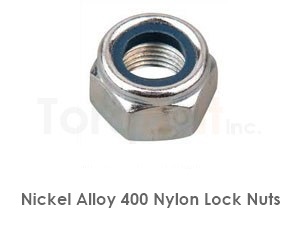
Monel 400 lock nuts ship in three locking families covered by the same ASTM F467 chemistry envelope (Ni 400, F 467U marking, UNS N04400). The nylon-insert variant, called Monel 400 nyloc or stop nut, follows DIN 985 / ISO 10511 / ASME B18.16.6 and uses a polyamide 6/6 ring to grip the thread. The Monel 400 prevailing torque nut in all-metal form follows DIN 980V or DIN 6924 and deforms the thread crest to generate friction. The castellated variant follows DIN 935 / ISO 7035 and locks through a split pin. Monel® is a registered trademark of Special Metals Corporation; TorqBolt is not authorized by, affiliated with or endorsed by Special Metals. Chemistry comes from ASTM B164 bar, paired with bolts to ASTM F468.
TorqBolt manufactures and stocks the three primary Monel 400 self-locking nut families. Selection is driven by service temperature, fluid environment, and reusability allowance from the customer specification.
| Subtype | Primary spec | Locking mechanism | Reuse cycles | Service ceiling |
|---|---|---|---|---|
| Nylon-insert (nyloc / stop nut) | DIN 985 / ISO 10511 / ASME B18.16.6 | Polyamide 6/6 ring deformation around thread | 5 to 15 (vendor data) | 120 deg C continuous |
| All-metal prevailing-torque | DIN 980V / DIN 6924 / IFI 100 | Deformed top crown gripping thread crest | 3 to 5 | Bolt material limit |
| Castellated (castle nut) | DIN 935 / ISO 7035 / ASME B18.2.2 | Six slots plus cross-drilled bolt and cotter pin | Unlimited (pin replaced) | Bolt material limit |
The polyamide 6/6 ring in DIN 985 nuts carries a continuous-service ceiling of 120 deg C and a short-duration peak of 150 deg C. Above the ceiling, the polymer softens, the prevailing torque collapses, and the nut behaves as a plain F467 hex nut. The ring is also incompatible with hydrofluoric acid, dilute caustic at elevated temperature, and aromatic hydrocarbons (HF alkylation acid lines, aromatic extraction). Exclude the nyloc variant from HF acid service, HF alkylation, and any joint inside the NACE MR0175 sour envelope where the polymer is not qualified for H2S exposure. The metal portion of the nut still meets F467 Ni 400; only the locking feature is unsuitable.
DIN 980V (one-piece pinched crown) and DIN 6924 (with friction ring of the same Monel 400 stock, not polymer) are the default lock-nut selections for chemical plant, HF alkylation, refinery downstream, and sour gas service. The locking mechanism is mechanical deformation of the nut top, so the friction torque is independent of temperature and resists hydrocarbon attack. The hardness signature follows ASTM F467 F 467U marking (75 HRB minimum), and the assembly automatically clears the NACE MR0175 / ISO 15156-3 35 HRC ceiling for nickel-copper alloys. Sour-service shipments include EN 10204 type 3.2 mill test certification and the NACE compliance statement. Detail on sour service applications.
Imperial 1/4 inch through 1-1/2 inch UNC and UNF (the F467 envelope). Metric M6 through M36 standard, M42 through M48 on indent. Heavy-pattern variants follow ASME B18.2.2 dimensions for the corresponding head pattern. All three locking subtypes are produced from the same ASTM B164 hot-finished bar so the chemistry is identical across patterns.
| Nominal size | Nyloc (DIN 985) height | All-metal DIN 980V height | Castle DIN 935 height incl. slots | Thread pitch (metric) |
|---|---|---|---|---|
| M6 | 6.0 mm | 6.0 mm | 9.5 mm | 1.0 |
| M8 | 8.0 mm | 8.0 mm | 13.0 mm | 1.25 |
| M10 | 10.0 mm | 10.0 mm | 15.0 mm | 1.5 |
| M12 | 12.0 mm | 12.0 mm | 18.0 mm | 1.75 |
| M16 | 16.0 mm | 16.0 mm | 24.0 mm | 2.0 |
| M20 | 20.0 mm | 20.0 mm | 30.0 mm | 2.5 |
| M24 | 24.0 mm | 24.0 mm | 36.0 mm | 3.0 |
| 1/2 in | 17/32 in | 17/32 in | 19/32 in | 13 UNC / 20 UNF |
| 3/4 in | 49/64 in | 49/64 in | 59/64 in | 10 UNC / 16 UNF |
| 1 in | 1-1/16 in | 1-1/16 in | 1-23/64 in | 8 UNC / 12 UNF |
ASTM F467/F467M sets the floor for Monel 400 nuts under the F 467U marking. The values below apply to the metal portion of the lock nut and govern proof-load acceptance for both nyloc and all-metal variants. Verified from ASTM F467/F467M Table 2 (Ni 400 row).
| Alloy | F467 marking | Hardness min | Hex nut proof stress (ksi) | Heavy hex proof stress (ksi) |
|---|---|---|---|---|
| Ni 400 (UNS N04400) | F 467U | 75 HRB | 80 | 86 |
| Ni 405 (UNS N04405, free-machining) | F 467V | 60 HRB | 70 | 76 |
The lock-feature prevailing torque (running torque before seating) is governed by the locking standard, not by F467. DIN 980V grade 8 specifies a maximum free-spinning torque after the first installation and a minimum prevailing torque after five reuses; DIN 985 specifies the same set of values for the nylon ring before degradation.
Monel 400 lock nuts populate three operating environments where loosening risk is a safety case. Instrumentation tie-rods on offshore platforms and FPSO topsides use DIN 935 castellated nuts with split pins on impulse-line manifolds where torque-only friction is not accepted by the IOGP S-563 instrumentation specification. Naval bulkhead, shaft coupling, and degaussing-coil mounts use DIN 985 nyloc or DIN 980V depending on the local temperature; the nickel-copper chemistry meets the non-magnetic requirement of NAVSEA standard hardware. Vibration service on rotating equipment, screw compressors in HF alkylation compressor houses, reciprocating pump valve covers in marine service, and seawater riser flange backing nuts on jackets use DIN 980V because the polymer ring would not last the inspection interval.
Standard supply is EN 10204 type 3.1 mill test certificate. Sour-service, nuclear safety class, and NORSOK projects ship with EN 10204 type 3.2 plus the NACE MR0175 compliance statement and the lock-feature torque test record. Marking on the wrench flat carries the F467 designator (F 467U), the heat number, and the manufacturer mark. Nyloc nuts carry an additional color code on the polyamide ring (white for unmodified, blue for high-temperature 150 deg C grade, red for fuel-resistant grade).
Nyloc versus all-metal: which one belongs on the joint? Use nyloc DIN 985 below 120 deg C in clean service. Use all-metal DIN 980V or DIN 6924 above 120 deg C, in any hydrocarbon environment, and for every sour-service application. The all-metal variant has a shorter reuse life (3 to 5 cycles versus 5 to 15 for nyloc) but it carries no temperature derate.
Are nylon-insert lock nuts approved for sour service? No. NACE MR0175 / ISO 15156-3 qualifies the metallic portion of the nut under F 467U marking, but the polyamide 6/6 ring is not qualified for H2S exposure and is not a NACE-listed material. For sour service, switch to all-metal DIN 980V or DIN 6924 in the same Monel 400 base.
What about HF acid and HF alkylation? Exclude the nyloc variant entirely. The polyamide ring degrades in HF and in the hydrocarbon-acid emulsion characteristic of HF alkylation reactor effluent. All-metal DIN 980V Monel 400 lock nuts are the API RP 751 default for any HF-wetted flange where lock nuts are required by the joint design.
Are lock nuts a substitute for double-nutting? Yes for vibration, but not for the safety-critical joint on a primary pressure boundary where the project specification calls for through-pin or wire locking. On those joints, use DIN 935 castellated with split pin or with stainless wire seal.
Pair with Monel 400 bolts to ASTM F468: hex bolts, heavy hex bolts, stud bolts. Plain (non-locking) nuts to ASTM F467 in the same Monel 400 base: nuts overview, hex nuts (DIN 934), heavy hex nuts (ASME B18.2.2). Pair the nut chemistry to the bolt to avoid galvanic discontinuity in the clamped joint and to keep the assembly inside one MTC.
Send nominal size, thread (UNC, UNF or metric coarse / fine), locking subtype (nyloc DIN 985, all-metal DIN 980V or DIN 6924, castle DIN 935), pattern (standard or heavy hex), nyloc ring color if specified, applicable customer spec and quantity to info@torqbolt.com or WhatsApp +91-22-66157017. Ex-Mumbai price and lead time returned within one working day. Domestic India 3 to 7 working days; export through JNPT.