
Specifications
Surface Treatments
Certifications
- ISO 9001 - 2015 Certified
- PED 2014/68/EC
- NACE MR0175/ISO 15156-2
- NORSOK M-650
- DFAR
- MERKBLATT AD 2000 W2/W7/W10
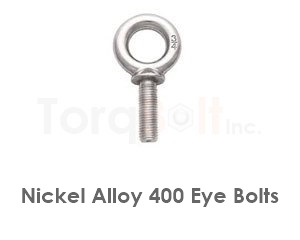
Monel® 400 anchor bolts (also called Monel 400 L-bolts, Monel 400 J-bolts, UNS N04400 anchor bolts, nickel-copper anchor bolts, or 2.4360 anchor bolts) anchor structural steel, equipment skids, jetty bollards and crane base plates to reinforced concrete in chloride-laden marine, sour gas and hydrofluoric acid service. The mechanical floor is set by ASTM F468 Class A (Ni 400, weldable); the embedded geometry follows the project structural drawing and may reference ASTM F1554 for dimensional convention. Chemistry derives from ASTM B164 bar; the alloy registers as UNS N04400 and DIN 17743 NiCu30Fe (2.4360). Monel is a registered trademark of Special Metals Corporation; TorqBolt is not authorized by, affiliated with or endorsed by Special Metals.
Four embedded-end profiles cover the anchorage envelope in nickel-copper. Geometry selection follows the rebar cage layout, slab thickness and required pull-out. Mechanical floor and material certification are identical across all four (F468 Class A).
| Geometry | Embedded shape | Hook / head dimensions | Specify when |
|---|---|---|---|
| L-bolt | 90 degree bend at the embedded end | Hook leg 4 to 6 times shank diameter; bend radius 3 times shank diameter | Shallow embedment, moderate pull-out, clear rebar layout |
| J-bolt | 180 degree return at the embedded end | J return 4 times shank diameter; bend radius 3 times shank diameter | Congested rebar cage where 90 degree leg interferes |
| Headed anchor | Hex or square head forged on the embedded end | Hex head 1.5 times shank across flats; embedment 8 to 12 times shank diameter | Maximum pull-out per inch of embedment; head bears in pure compression |
| Swedged anchor | Rolled deformations along the embedded length | Deformation pitch 1 to 2 times shank diameter; full bond on embedment length | No hook clearance; bond-controlled anchorage; thin slab pours |
Anchor design follows ACI 318 Chapter 17 (anchorage to concrete) and the structural engineer's calculation governs embedment depth. Three failure modes drive the design: concrete cone breakout, steel tensile fracture and pull-out. The F468 Class A floor (70 to 130 ksi tensile) exceeds the cone breakout capacity of typical 4000 to 6000 psi concrete at the embedment depths used in marine and chemical-plant foundations, so concrete strength and edge distance govern the load envelope. Headed anchors with embedment of 8 to 12 times the shank diameter develop near-full F468 yield; L-bolts and J-bolts develop 60 to 80 percent of headed-anchor capacity at the same embedment. Edge distance below 6 times the shank diameter triggers a side-face blowout check per ACI 318 17.6.4.
Sizes are produced from ASTM B164 hot-finished bar (condition AR or HF, sulfur 0.024 max for Class A). M48 through M64 and 1-3/4 through 2-1/2 inch indent through ASTM B564 forging stock with mechanicals matched to F468 Heavy Forged Equivalent. Thread cut to ASME B1.1 UNC or ISO 261 metric coarse; projecting thread length is typically 3 to 5 times the shank diameter.
| Metric size | Tensile area (sq.mm) | Imperial size | Tensile area UNC (sq.in) | Typical stocked length |
|---|---|---|---|---|
| M16 | 157 | 5/8 | 0.226 | 200 to 600 mm / 8 to 24 in |
| M20 | 245 | 3/4 | 0.334 | 250 to 750 mm / 10 to 30 in |
| M24 | 353 | 7/8 | 0.462 | 300 to 900 mm / 12 to 36 in |
| M27 | 459 | 1 | 0.606 | 350 to 1050 mm / 12 to 48 in |
| M30 | 561 | 1-1/8 | 0.763 | 400 to 1200 mm / 14 to 48 in |
| M36 | 817 | 1-1/4 | 0.969 | 500 to 1500 mm / 18 to 60 in |
| M42 | 1120 | 1-1/2 | 1.405 | 600 to 1800 mm / 24 to 60 in |
| M48 | 1470 | 1-3/4 | 1.90 | 700 to 2000 mm / indent |
| M56 | 2030 | 2 | 2.50 | 800 to 2200 mm / indent |
| M64 | 2680 | 2-1/2 | 3.25 | 900 to 2500 mm / indent |
Anchor bolts in Monel 400 are supplied to ASTM F468 Class A (UNS N04400, sulfur 0.024 max, weldable). Class B (UNS N04405, sulfur 0.025 to 0.060) is not recommended for embedded service because the higher sulfur compromises field welds to the rebar cage and reduces toughness. The verified F468 Class A floor (source: ASTM F468/F468M-2016 Table 2) is reproduced below.
| F468 marking | Diameter (in) | Hardness | Tensile (ksi) | Tensile (MPa) | Yield min (ksi) | Yield min (MPa) | Elongation |
|---|---|---|---|---|---|---|---|
| F 468U | 0.250 to 0.750 | 75 HRB to 25 HRC | 80 to 130 | 552 to 896 | 40 | 276 | 20% |
| F 468U | 0.875 to 1.500 | 60 HRB to 25 HRC | 70 to 130 | 483 to 896 | 30 | 207 | 20% |
| F 468U4 | 0.875 to 1.500 | 75 HRB to 25 HRC | 80 to 130 | 552 to 896 | 40 | 276 | 20% |
| F 468HF | all (heavy forged equivalent) | 60 to 95 HRB | 70 to 120 | 483 to 827 | 30 | 207 | 20% |
F468 caps hardness at 25 HRC across the embedded service range, well inside the 35 HRC ceiling set by NACE MR0175 for nickel-copper bolting in H2S service. Anchor bolts therefore clear the sour-service hardness gate by design. Each lot ships with EN 10204 type 3.2 mill test certificate covering chemistry, mechanicals, hardness, and dimensional inspection.
Anchor bolts ship as a kit: bolt + two nuts + two washers + leveling sleeve when specified. Nut chemistry matches the bolt to prevent galvanic discontinuity at the flange interface.
Marine jetty bollards and dolphin foundations: Splash-zone exposure to chloride seawater pits austenitic stainless (316L) and crevice-attacks duplex grades at the concrete interface. Monel 400 anchors resist seawater chloride attack through the splash zone. Detail in marine engineering and seawater corrosion.
HF alkylation equipment foundations: Monel 400 is the default bolting on HF-wetted flanges per API RP 751. Foundation anchors for HF alkylation pumps, drums and exchangers match nickel-copper chemistry to the flange bolting to hold a single corrosion potential at the equipment skirt. Detail in HF acid resistance and HF alkylation.
Naval crane bases and deck-mounted equipment: Magnetic permeability of Monel 400 stays below 1.001 in the annealed condition, qualifying the anchor for non-magnetic hardware on minesweepers and degaussing-coil installations. Headed and swedged geometries dominate naval specifications because the structural pour is shallow over deck plating.
L-bolt versus J-bolt versus swedged? L-bolt suits shallow embedment with moderate pull-out (90 degree leg). J-bolt clears rebar interference (180 degree return). Headed anchor delivers the highest pull-out per inch of embedment. Swedged anchor develops bond along the full embedded length where rebar interference rules out hook geometries.
What is the standard length? Project drawing governs. Indicative: M16 in 200 to 600 mm; M24 in 300 to 900 mm; M36 in 500 to 1500 mm; 5/8 inch in 8 to 24 inch; 1 inch in 12 to 48 inch; 1-1/2 inch in 18 to 60 inch.
What embedment depth applies? Set by the structural engineer per ACI 318 Chapter 17. Typical cast-in headed anchors run 8 to 12 times the shank diameter. Pull-out is concrete-governed because the F468 Class A tensile floor (70 to 130 ksi) exceeds typical concrete cone breakout capacity.
Companion pages: Monel 400 bolts (F468 hub), foundation bolts (heavier section), threaded rod (cut-to-length anchor rod), U-bolts, eye-bolts, stud bolts, and ASTM F468 specification. The nickel-copper alloy family covers metallurgy across Monel 400 / R-405 / K-500.
Send geometry, shank diameter, embedded length, projecting thread length, spec, drawing reference and quantity to info@torqbolt.com or WhatsApp +91-22-66157017. Ex-Mumbai price and lead time returned within one working day. Domestic India 3 to 7 working days; export through JNPT. Each shipment carries EN 10204 type 3.2 plus the NACE MR0175 statement when sour service is specified.